
A plain-English guide to VRF for building owners.
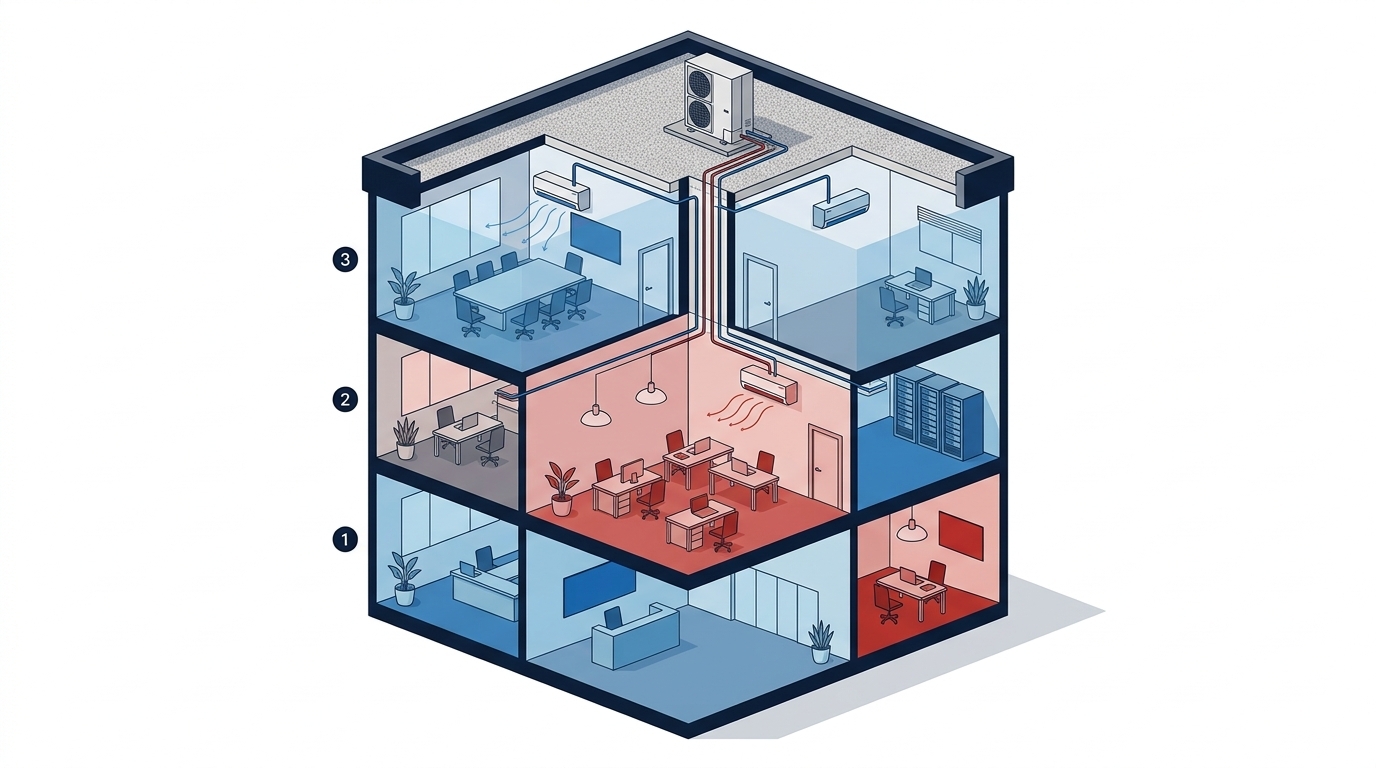
If you own or manage a commercial property, someone has probably pitched you VRF. It's been the fastest-growing commercial HVAC technology of the past decade — and with good reason. But the pitches tend to be heavy on jargon and light on what you actually need to know. This is the version we wish more building owners were handed.
What VRF actually is
VRF stands for Variable Refrigerant Flow. Here's the plumbing analogy: instead of one big system trying to heat or cool your whole building evenly, VRF uses one outdoor unit connected to multiple indoor units — one per zone, room, or tenant space. Refrigerant flows between them, and the system automatically sends heating or cooling exactly where it's needed, in real time.
Three things make it different from traditional HVAC:
- Zone-by-zone control. Every indoor unit has its own thermostat and its own setpoint.
- No ductwork required. Refrigerant lines are small and flexible, which makes VRF ideal for retrofits.
- Variable output. Instead of cycling on and off at full blast, VRF ramps up and down smoothly based on demand.
What you'd notice if your building had one
Forget the spec sheet for a second. Here's the day-to-day experience of working in a VRF-equipped building.
Rooms stay the temperature you set. Not close to it — at it. Conventional systems overshoot and undershoot; VRF holds steady within about half a degree.
Different zones can run differently at the same time. In a multi-tenant building, one tenant can cool a server room while the tenant next door heats their conference room — from the same system. A single outdoor unit, two different jobs, simultaneously.
It's quiet. Indoor units at low fan are around 19 dB — quieter than a whisper. Outdoor units are quieter than most conventional rooftop equipment too, which matters when your building has neighbors.
The money side
VRF systems typically cut HVAC energy consumption by up to 30% compared to conventional systems. That number gets quoted a lot, so let's translate it into something concrete.
For a 25,000 sq ft commercial building with a $50,000 annual HVAC bill, a 30% reduction can translate to roughly $15,000 back every year.
Two honest caveats. First: upfront cost is higher than traditional HVAC — often meaningfully so. A realistic VRF payback period for a commercial retrofit is five to eight years. Second: actual savings depend on the building, how it's used, and how well the system is designed. "Up to 30%" is the ceiling, not the guarantee.
A few other cost factors worth knowing: VRF usually requires less ductwork (which can shrink mechanical rooms and free up rentable square footage), and both federal and utility-level incentives for high-efficiency HVAC are often available. Your contractor should know what's current in your area.
When VRF is right — and when it isn't
This is the part most pitches skip. VRF isn't the right answer for every building, and a contractor who tells you otherwise is selling, not advising.
- Multi-tenant office buildings and medical offices
- Retrofits where new ductwork would be disruptive or impossible
- Hospitality — hotels, senior living, assisted living
- Buildings with uneven occupancy (some areas empty, others busy)
- Projects where simultaneous heating and cooling is a real requirement
- Large open-plan warehouses with uniform temperature needs
- Projects where the higher upfront cost can't be justified by the payback
- Buildings with extreme loads — very high ceilings, heavy process cooling — that are better served by dedicated equipment
If VRF isn't the right fit for your building, a good contractor will tell you, explain why, and recommend what is.
What a VRF project actually looks like
Start to finish, this is the typical path from first conversation to working system.
-
Site walkthrough and load calculation
Your contractor visits the building, maps zones, measures loads, and understands how the space is actually used. This is the single most important step — a bad load calc leads to an undersized or oversized system that never performs right.
-
System design
Zone layout, equipment sizing, refrigerant line routing, and controls. You'll get a proposal with equipment specs, installation scope, and cost.
-
Equipment ordering
Lead times for VRF equipment vary by manufacturer and availability. Plan for this in your project timeline rather than assuming immediate ship.
-
Installation
Timeline depends on building size and scope. Retrofits can often be phased so tenants stay operational. A well-run install keeps disruption low.
-
Commissioning and handoff
The system is tested, balanced, and dialed in for the actual building. Your facility team gets a walkthrough of the controls, the service access, and what normal operation looks like.
Questions to ask any HVAC contractor
Whether you're getting a quote from us or from someone else, these are the questions that separate a real specialist from a company that just happens to sell VRF equipment.
- Are you manufacturer-certified on the VRF brand you're recommending? Which manufacturers?
- Do your own technicians do the install and service, or do you subcontract it?
- What's the warranty on labor separately from the warranty on equipment?
- Can I talk to two or three past clients with a similar-size project?
- When something breaks at 8pm on a Friday, who answers the phone?
- Will you walk my facility team through the system at handoff, and provide documentation we can keep?
Any contractor who can confidently answer all six is worth serious consideration. Anyone who dodges one of them is telling you something important.
Where MMS fits in
MMS is a Metro Detroit commercial-first HVAC contractor. We're manufacturer-certified on all the major VRF brands — Daikin, Mitsubishi Electric, LG, Lennox/Samsung, and York/Hitachi. Our technicians are in-house, our service is 24/7 for commercial accounts, and we stay with the buildings we install in for the long run.
If you're evaluating VRF for your building and want a straight answer about whether it's the right fit, that's the conversation we'd like to have.